
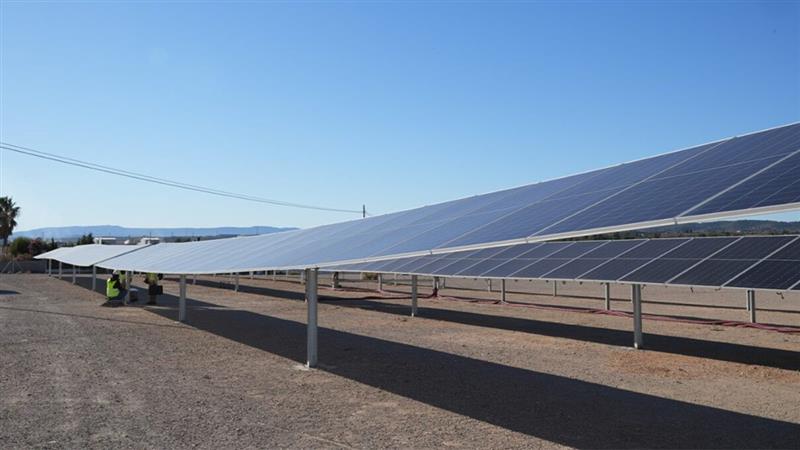
African solar market growth driven by efficiency is reshaping the energy landscape. With demand rising, smart trackers are proving essential for profitability. Africa is in the midst of a solar gold rush. According to Wood Mackenzie’s Africa Solar PV Market Outlook 2025, cumulative solar PV capacity is projected to hit 163 GWdc by 2034, growing almost eight-fold over the coming decade. As governments, investors, and IPPs race to meet renewable targets, efficiency, reliability, and cost‐per‐kWh are becoming the critical differentiators in project success. That’s where smart solar trackers come in, and where PVHardware is proud to be the number one supplier of PV trackers in the region.
The Case for Solar Trackers
Solar trackers, which follow the sun throughout the day, can improve yields by 20–30% (or more under certain conditions) compared to fixed-tilt systems. In Africa’s varied terrain, from rolling plains to undulating hills, PVH’s AxoneDuo Infinity tracker with its terrain-follow feature, promising a ±2° tolerance per post, comes as a breakthrough, ensuring even the most challenging terrains can be home to large-scale solar farms.
Furthermore, Wood Mackenzie’s 2025 outlook highlights that the most successful PV projects are those combining high solar irradiance, favorable policy frameworks, strong grid access, and cost reductions from balance‐of‐system (BOS) innovations, including advanced tracker designs.
Our Leadership in Africa
We are honored to hold the top spot in Africa for PV tracker supply in 2025, according to Wood Mackenzie, delivering more tracker systems than any other provider. Our clients trust us not only for advanced solar trackers but also for our fast delivery timelines. Being a local supplier adds further value to our portfolio. As the market intensifies, being able to offer trackers that adapt to site complexity is no longer optional, it is essential.
Efficiency: The Key to African Solar Market Growth
African solar market growth driven by efficiency is defining which projects succeed in the long run. At PVHardware, we understand that beyond irradiance and policy frameworks, efficiency is what turns potential into profitability. That is why our solutions are designed not only to adapt to Africa’s diverse terrains but also to maximize performance and minimize operational risks.
Efficiency also plays a decisive role in reducing LCOE and ensuring the long-term viability of projects. By integrating innovation into every stage, from design to installation, PVHardware guarantees that our partners achieve maximum yields with lower risks. This efficiency-driven approach is setting a new standard for Africa’s booming solar industry.
The AxoneDuo Infinity: Terrain Response and 2° Slope Variation
To meet this need, we have upgraded our best-selling tracker, the AxoneDuo Infinity, with Terrain Response capability. This new feature allows for up to ±2° slope variation post to post, enabling the tracker to adapt to site undulations without sacrificing module alignment or structural stability. The result: increased energy yield, better structural tolerances, simplified installation, and reduced groundworks and grading costs.
What This Means for Profitability
- Reduced BOS and site prep costs – less grading and lower civil works when terrain variation is tolerated.
- Improved reliability and lower O&M risk – structural stress is mitigated, leading to fewer mechanical failures.
- Faster deployment – simpler site prep and adaptable trackers mean shorter timelines to commissioning.
The Bottom Line
As the African solar market accelerates, efficiency is king. Trackers that are merely basic will struggle to unlock full project profitability. With our leadership in tracker supply in the region, combined with innovations such as Terrain Response in the AxoneDuo Infinity, PVHardware is setting the standard for smart, robust, profitable solar projects. The solar gold is there, the winners will be those who track it wisely.