
When designing a utility-scale solar plant, the geometry of the torque tube is far more than a structural preference. It directly dictates the stability of the trackers under extreme weather conditions, the speed of installation, and—critically—the total cost of raw materials.
For years, EPCs and developers have been forced to choose between two traditional options: round or square profiles. At PVHardware (PVH), we knew the industry needed a more highly optimized structural baseline. In 2021, we shifted our standard to the octagonal torque tube. Here is the science and the economic reality behind that decision.
The Mechanical Dilemma: Round vs. Square
Tracker design is a constant battle against two primary forces: torsion (twisting) and bending (flexion).
- Round Tubes: Governed by torsion. When a tracker is free between supports, a round tube offers excellent torsional stiffness, making it mechanically ideal for long rows. However, integrating a perfectly round tube with structural components and solar modules is difficult and time-consuming because it lacks flat mounting surfaces. Furthermore, round tubes show weaker performance against bending forces.
- Square Tubes: Governed by bending. Square profiles offer flat faces, making structural connections fast, direct, and highly secure. They handle bending well, especially when supported by fixed posts. However, their torsional performance drops significantly as row lengths increase, making them a mechanical liability in high-wind environments.
The Octagonal Solution: Engineering the Middle Ground
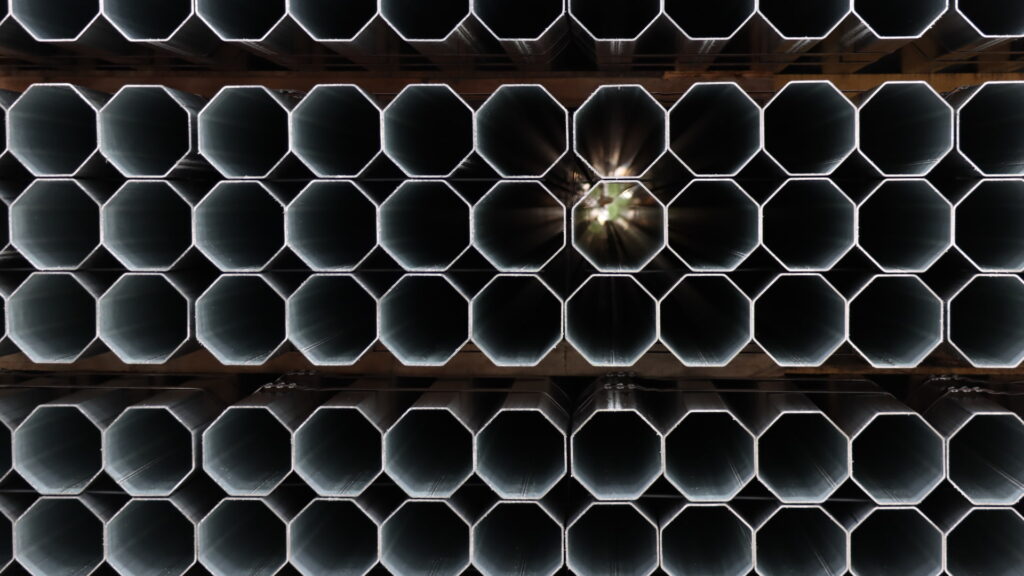
The octagonal torque tube bridges the gap between these two extremes. It achieves torsional resistance values nearly identical to perfectly round tubes, ensuring the tracker can manage accumulated torsion across long rows without risking aeroelastic instability. Simultaneously, its eight flat sides provide the secure, precise mounting surfaces needed to expedite module installation and eliminate complex clamping systems.
But the true advantage of the octagonal shape goes beyond basic mechanics. It directly impacts project CAPEX by altering how the steel behaves under stress.
Controlled Local Buckling and Steel Optimization
Steel accounts for the largest portion of a solar tracker’s cost. When engineers try to lower costs by using thinner steel, they hit a hard physical limit: local buckling. Under heavy wind loads, flat steel surfaces tend to wrinkle or collapse before the overall tube reaches its theoretical yield strength.
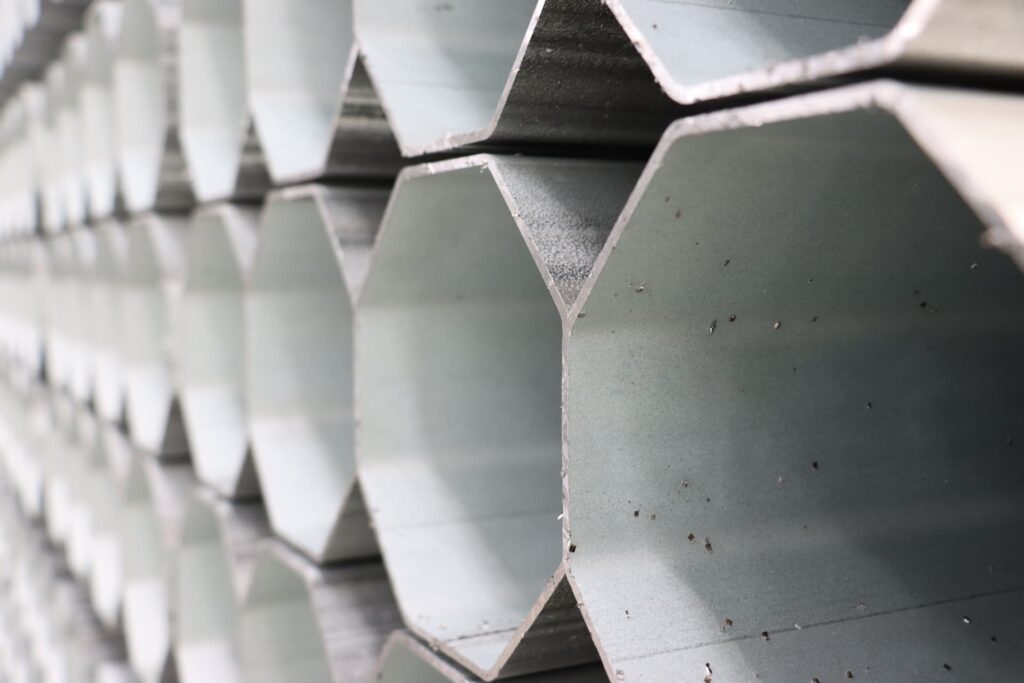
By moving to an octagonal section, we shorten the width of each individual flat face. This heavily optimizes the width-to-thickness ratio ($b/t$). In this geometric configuration, the longitudinal folds do not just form the shape—they act as structural stiffeners that stabilize the steel sheet.
This optimization allows us to safely reduce the wall thickness of the tube while maintaining the exact same structural integrity and wind rating as a thicker square tube. For a multi-megawatt project, this engineering adjustment translates directly into millions of dollars saved in raw steel and a massive reduction in the number of shipping containers required for transport. It is the science of doing more with less weight.
Sourcing and Manufacturing: Eliminating Third-Party Risk
A common criticism of octagonal tubes is that they are difficult to source. Because the geometry requires highly precise bending angles, standard third-party steel mills often struggle to meet the strict tolerances required during roll-forming. Minor errors in the angles accumulate, leading to alignment issues during field installation.
While this supply chain bottleneck is true for companies relying on external suppliers, it is irrelevant for PVH. We maintain full control over our in-house manufacturing process. We roll-form our own steel, guarantee our own strict tolerances, and eliminate external logistics delays. We control the quality from raw coil to the final post.
Total Site Adaptability
In our #Infinity tracker, the octagonal tube does not work alone; it pairs with mechanical stoppers at every single post. This combination provides the flexibility to absorb varying atmospheric loads, neutralize bending stress, and adapt to any complex terrain layout without increasing structural weight.
By upgrading the geometric baseline of the tracker, we have spent the last four years proving that you can reduce CAPEX, accelerate installation, and increase wind resistance simultaneously.
Discuss Your Next Project with Our Experts
Every solar plant has unique structural and financial requirements. If you are looking to optimize the geometry and economics of your next utility-scale project, reach out to our team.
Led by Head of Engineering Estela Perez, our in-house experts are ready to analyze your site data and show you exactly how the PVH Infinity system can reduce your CAPEX while maximizing structural reliability.
