
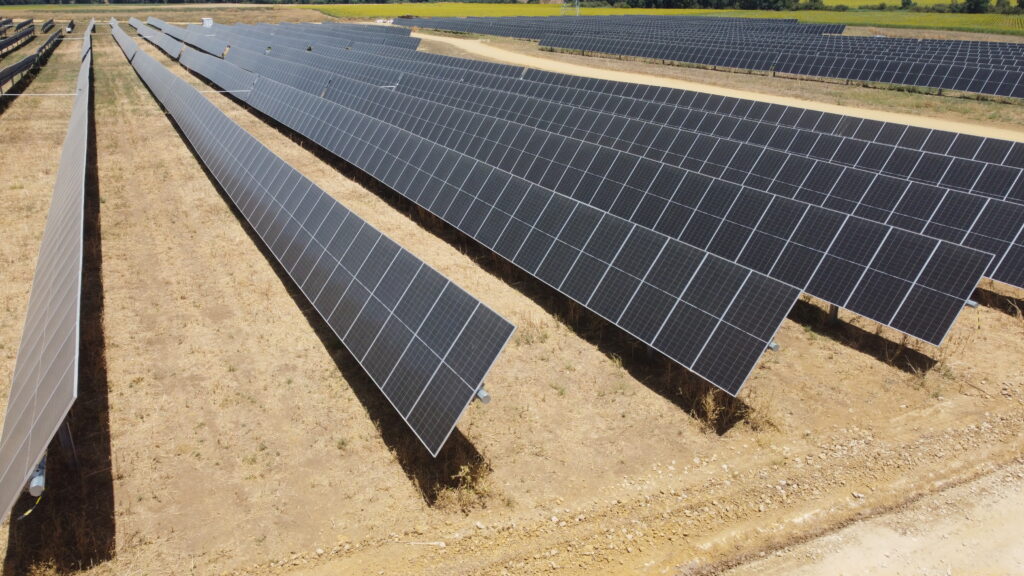
Understanding how solar trackers perform under extreme temperatures is critical to ensuring long-term reliability and operational efficiency.
In regions like Southern Spain, where ambient temperatures can exceed 45°C, thermal performance becomes a key factor in solar project reliability and execution.
This analysis documents real operating conditions and evaluates how PVH solar tracker components perform under high-temperature environments.
Objective
The purpose of this study is to assess the behavior of PVH solar tracker components under extreme thermal conditions, focusing on their ability to maintain performance and ensure service continuity.
Environmental baseline analysis
To establish a climatic reference, data from the PVGIS (Photovoltaic Geographical Information System) database was used. This platform provides reliable historical solar and meteorological data.
- Reference location: Seville, Spain
- Maximum recorded temperature: 45°C
This baseline confirms that the region operates under high-temperature conditions, making it a relevant case for evaluating system performance in utility-scale solar projects exposed to extreme heat.
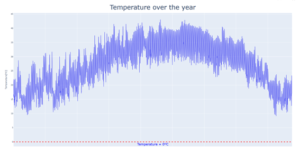
Caption: PVGIS historical temperature data for Seville, Spain
Field operational data
PVH operates across multiple solar projects in the region. For confidentiality reasons, plant names and exact locations are not disclosed.
The analysis focuses on two key measurement points:
- Ambient temperature (TBox meteorological station)
- Internal tracker temperature (DBox controller)
These are critical to understanding both external thermal stress and internal system performance under real operating conditions.
Ambient temperature (TBox meteorological station)
The meteorological station installed in the TBox records real ambient conditions affecting the plant.
- Recorded temperature: 45.0°C
- Timestamp: July 30, 2025 – 13:32
These values represent the actual environmental conditions experienced on site during peak solar hours.
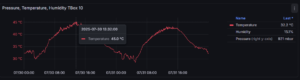
Caption: Ambient temperature recorded at site (TBox)
Temperature inside trackers (DBox)
Internal temperatures were monitored in the DBox controllers installed on each tracker.
- Recorded temperature: 57.31°C
- Timestamp: July 30, 2025 – 13:40
This data confirms that, even under extreme ambient conditions, PVH tracker electronics operate within safe and controlled ranges, validating the effectiveness of enclosure design and passive thermal dissipation systems.
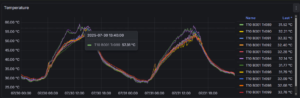
Caption: Internal temperature at DBox controller under peak conditions
Tracking performance under thermal stress
The tracking process was also analyzed to ensure system functionality during peak temperature conditions.
- The green line represents the setpoint sent from the TBox (based on sun position)
- The blue line represents the actual tracker tilt
At 13:40, despite high temperatures, the tracker continued operating normally with a tilt of 30°, maintaining expected tracking behavior throughout the day.
This confirms that thermal stress does not impact tracking accuracy or system responsiveness.
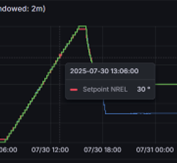
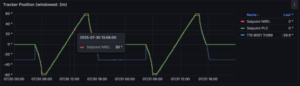
Caption: Tracker performance under high-temperature conditions
Key findings
The collected data confirms that solar trackers operating in Southern Spain are exposed to highly demanding thermal conditions.
Despite this:
- Controllers remain within safe operating ranges
- Tracking performance is maintained without disruption
- System behavior remains stable during peak temperature periods
From an execution perspective, this is critical. Maintaining performance under thermal stress ensures project reliability, reduces operational risks, and supports long-term asset performance.
Reliability under extreme conditions
Thermal performance is a critical factor in solar project reliability, especially in regions with high ambient temperatures.
This analysis shows that, even under extreme conditions exceeding 45°C, PVH solar trackers maintain operational stability and ensure continuous performance.
By combining robust component design, engineered solutions, and optimized thermal management, PVH systems are built to perform in demanding environments.
Because in solar projects, performance is not only about energy yield, it’s about ensuring that systems operate reliably under real-world conditions.
If you’re developing solar projects in high-temperature regions, understanding how systems perform under real operating conditions is key.
👉 Explore how PVH solutions support reliable execution and long-term performance
Insights by our Solar Expert: Carlos Gabriel Araujo – Presales engineer at PVH
