
When engineering utility-scale solar projects across Australia—including projects located within Renewable Energy Zones (REZs)—developers and EPC contractors operate in one of the most demanding procurement and construction environments in the world. While Australia benefits from world-class solar irradiance, project economics face significant pressure from two compounding factors: remote and challenging site conditions, and some of the highest construction labor costs globally.
For years, procurement teams have attempted to protect financial yields by negotiating lower hardware quotes on steel or solar trackers. However, squeezing component-level pricing addresses only a fraction of the total Balance of System (BOS) budget. On Australian soil, the true operational risk lies in field labor complexity, lengthy mechanical installation cycles, and field rework.
To maintain asset bankability and protect engineering schedules, the focus must shift from initial hardware cost to rapid field execution speed.
The Australian installation bottleneck
Executing utility-scale projects in Australia presents a unique set of field challenges:
- Escalating Labor Expenditures: On-site mechanical assembly commands premium hourly rates, particularly in remote regions where site mobilization and local labor rates add substantial overhead.
- Bill of Materials (BOM) Overhead: Conventional trackers rely on thousands of loose fasteners, individual brackets, and intricate sub-assemblies, leaving crews exposed to field assembly errors and extended installation timelines.
- Topographical and Earthwork Hurdles: Traditional rigid structures often require extensive site grading to accommodate slope variations, triggering site-prep cost overruns and lengthy environmental permitting delays.
When mechanical installation schedules stall due to site complexities, daily labor burn rates quickly erode profit margins. Solving these on-site execution delays requires structural engineering that systematically removes manual labor from the field.
Engineering for velocity: the PVH structural advantage
PV Hardware (PVH) addresses the Australian market’s labor challenges through deliberate hardware design and pre-assembly logic. By shifting mechanical assembly complexity from the field into controlled manufacturing processes, field operations are streamlined into high-speed execution.
1. Factory pre-assembly and direct labor savings
Field assembly efficiency is fundamentally tied to part count and labor hours. In response, PVH flagship architectures—such as AxoneDuo Infinity™—are delivered pre-assembled from the factory, saving up to 40% of field labor hours on site.
Key mechanical innovations designed to accelerate field schedules include:
- Pre-Assembly Service: Critical components arrive pre-assembled from the factory to minimize manual handling and reduce man-hours on site to a minimum.
- Flexible Drive Configurations: Engineered for linked or unlinked rows with displacement between rows of ±5° N/S, accommodating natural site elevation variances without manual field modifications.
- Lowest Motor and Controller Density: AxoneDuo Infinity™ features the lowest number of motors and controllers per MW on the market, reducing electrical connections, field programming requirements, and downstream O&M touchpoints.
2. Terrain-following adaptability without earthworks
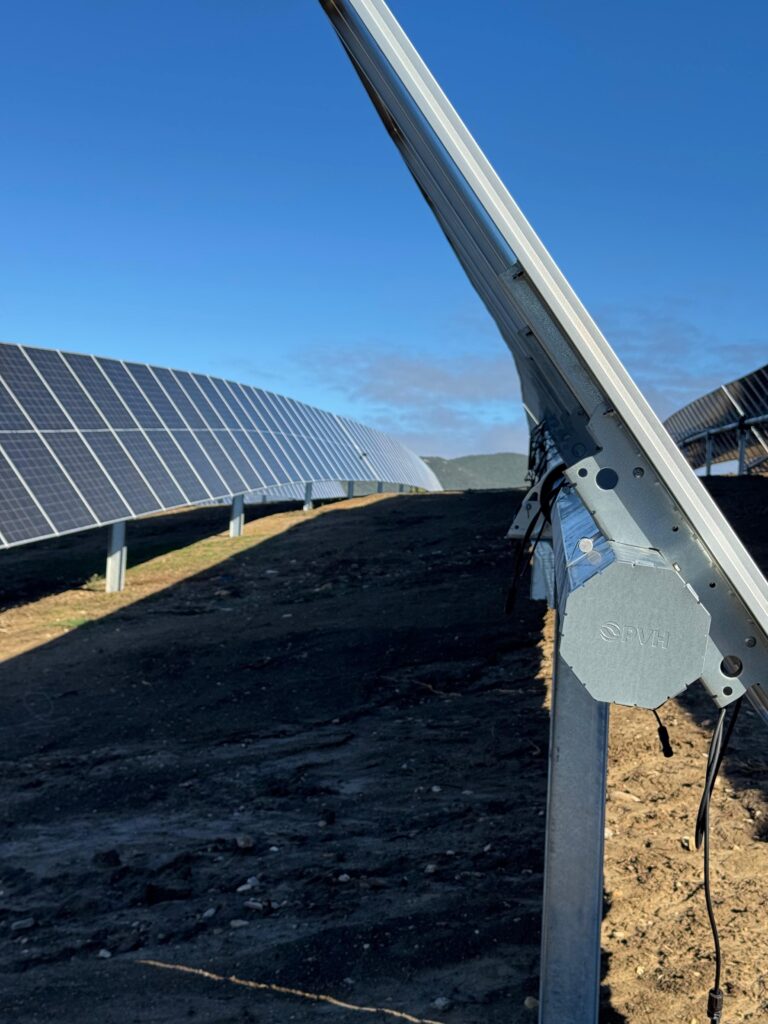
Site-preparation works represent one of the most unpredictable cost variables in utility-scale solar development. Traditional tracker architectures demand flat terrain, forcing developers into costly earth-moving operations. PVH integrates advanced Terrain Response™ capability across its tracking configurations.
3. Supply chain resilience and up to 95% Australian content
Speed of installation requires on-time, sequence-aligned site deliveries. By supplying up to 95% local Australian steel content across key projects, PVH helps developers satisfy local content frameworks while insulating project schedules from international shipping delays.
PVH further strengthens supply-chain resilience through its wholly owned manufacturing facilities, providing flexible sourcing alternatives beyond China. This diversified manufacturing footprint enables PVH to reduce exposure to the anti-dumping duties that may apply to certain Chinese steel tube imports—including rates of up to 48%—while maintaining direct control over manufacturing quality, production capacity and delivery schedules. The result is greater cost certainty, fewer tariff-related risks and a more reliable supply pathway for Australian utility-scale solar projects.
A data-driven impact on total installed cost
| Architectural metric | Traditional tracker systems | PVH Optimized solutions | Direct field / financial benefit |
|---|---|---|---|
| Field assembly complexity | High loose-part count | Delivered pre-assembled (up to 40% labor savings) | Dramatically faster mechanical assembly and lower field labor overhead. |
| Site grading requirements | Substantial land leveling required | Terrain Response™ (up to 15% N-S / E-W slope) | Reduced earthworks CAPEX and faster permitting. |
| Actuation infrastructure | High motor/controller density | Lowest motors and controllers per MW | Lower commissioning labor and streamlined electrical scope. |
| Supply chain compliance | High import dependency | Up to 95% Australian steel content | Alignment with REZ/CIS tenders and mitigated logistics risks. |
De-risking the asset from day one
In Australia’s competitive renewable energy environment, project viability is determined by construction execution speed and risk management. Attempting to manage high labor costs simply by sourcing cheaper components introduces structural vulnerabilities and costly operational delays.
By deploying pre-assembled, terrain-flexible tracking systems paired with localized supply chains, PV Hardware enables EPCs and developers to accelerate mechanical completion, lower total installed costs, and deliver fully bankable assets built for Australian conditions.
Looking to reduce field labor costs and de-risk your next project? Discover how PVH solar tracker pre-assembly streamlines utility-scale execution.
