
In utility-scale solar, year-one performance often dominates headlines. But serious investors, EPCs, and asset owners know the real question isn’t how a plant performs in month one — it’s how it performs in year 25.
Designing for long-term yield means engineering every structural, mechanical, and control component to maintain performance under decades of environmental stress. At PV Hardware (PVH), this philosophy drives both product development and R&D investment.
Year-One Gains Can Be Misleading
A tracker optimized solely for initial energy capture may produce impressive simulation results. However, degradation mechanisms begin immediately.
These include structural fatigue from cyclical wind loading, corrosion in high-humidity or desert environments, drivetrain wear caused by daily rotation, and control inaccuracies that lead to cumulative misalignment.
Even small annual efficiency losses can compound significantly over a 25–30 year asset life. For this reason, long-term yield design focuses on preventing these losses before they occur.
Engineering for Structural Longevity
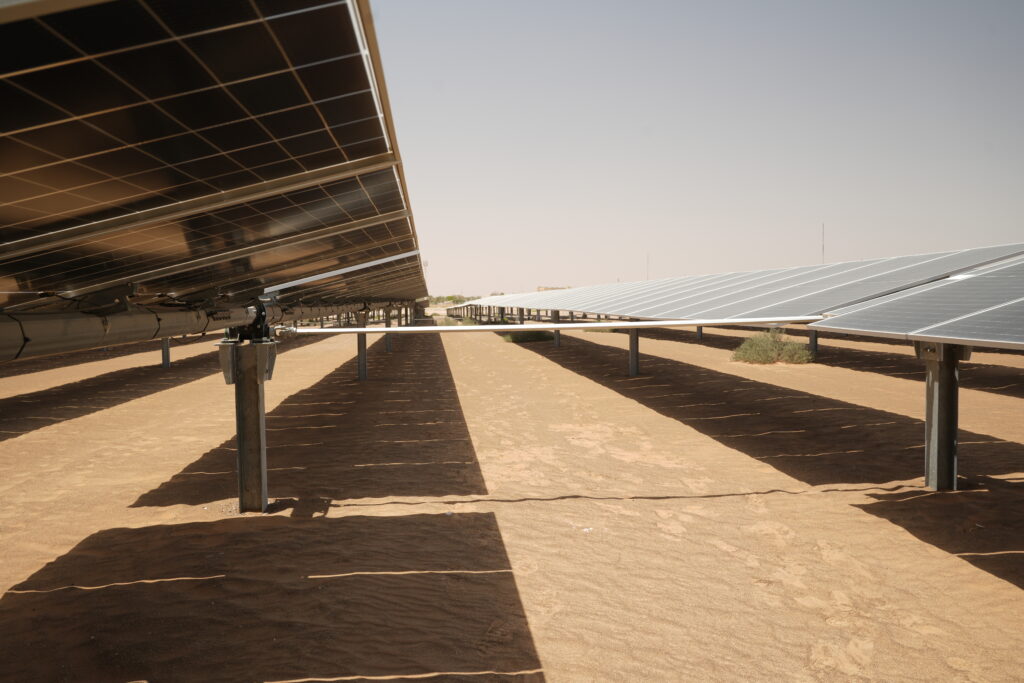
Tracker systems operate in some of the world’s harshest climates, including high-irradiation deserts, coastal environments exposed to salt, and high-wind regions.
Ensuring long-term durability requires reinforced structural architectures designed for extreme wind conditions, corrosion-resistant materials suitable for aggressive environments, and robust drivetrain configurations engineered for mechanical stability. In addition, active measures are implemented to mitigate wind loads through springs and hydraulic dampers integrated into the system design.
This approach is not only about surviving extreme weather events. It is about minimizing micro-movements, torsion, and long-term structural fatigue, factors that can gradually reduce system performance over time.
Precision That Lasts
Tracking accuracy has a direct impact on lifetime energy production. Over time, mechanical play, actuator degradation, or uneven terrain adaptation can introduce alignment errors.
Long-term system design therefore integrates high-stiffness torque tube systems, optimized motor and transmission configurations, and intelligent control systems calibrated for sustained precision.
Even a fraction of a degree in misalignment, repeated daily over decades, can translate into measurable energy losses. Ensuring alignment stability helps prevent strong initial performance from gradually declining during mid-life operation.
Designing for O&M Reality
Year-one performance models typically assume ideal maintenance conditions. In reality, projects often face limited site access, harsh environmental wear, and operational budget constraints.
For this reason, long-term yield design also prioritizes reducing component count to minimize failure probability, simplifying maintenance access, and using durable materials that extend service intervals.
The result is lower operational risk and higher lifetime availability, two key drivers of LCOE optimization.
R&D Beyond the Datasheet
The global tracker market has matured rapidly, and competition is increasingly shifting from initial CapEx toward long-term performance.
Industry trends show that asset owners now prioritize:
- Proven installed base
- Wind and structural bankability validation
- Long-term performance guarantees
- Sustainability of materials and supply chains
Continuous investment in R&D is essential to improve corrosion resistance, structural efficiency, and system reliability as climate conditions continue to evolve.
Designing for long-term yield means anticipating 25 years of wind events, temperature cycles, and operational variability — not just passing factory tests.
The Real Metric: Energy Over 25 Years
The true benchmark for tracker performance is not year-one output — it is cumulative lifetime generation.
When structural integrity, drivetrain durability, and precision control remain stable over decades, the result is:
- Higher lifetime MWh generation
- Reduced downtime
- Lower replacement costs
- Greater investor confidence
In today’s market, where financing models and PPAs increasingly scrutinize long-term performance, designing for durability is no longer optional — it is strategic.
Because in utility-scale solar, the projects that succeed are not the ones that shine brightest in year one.
They are the ones still performing at their best in year 25.
That is our commitment: to support project sites throughout their entire design life.