
In utility-scale solar, labor remains one of the most sensitive variables in project execution. Even when design, procurement, and logistics are well managed, installation performance still depends heavily on crew productivity, labor availability, and how much work must still be completed on site. That is why field labor savings have become one of the most relevant advantages of a pre-assembled solar tracker.
Why does field labor remain such a critical variable?
For EPC teams, field labor is not only a cost issue. It is also a matter of schedule, coordination, and execution capacity. The more assembly work that must be completed on site, the greater the dependence on crew organization, supervision, material handling, and daily installation consistency.
In utility-scale projects, small inefficiencies repeated thousands of times can create a significant cumulative impact. That is why any solution that reduces manual operations in the field can make a meaningful difference in both productivity and predictability.
How does a pre-assembled solar tracker reduce work on site?
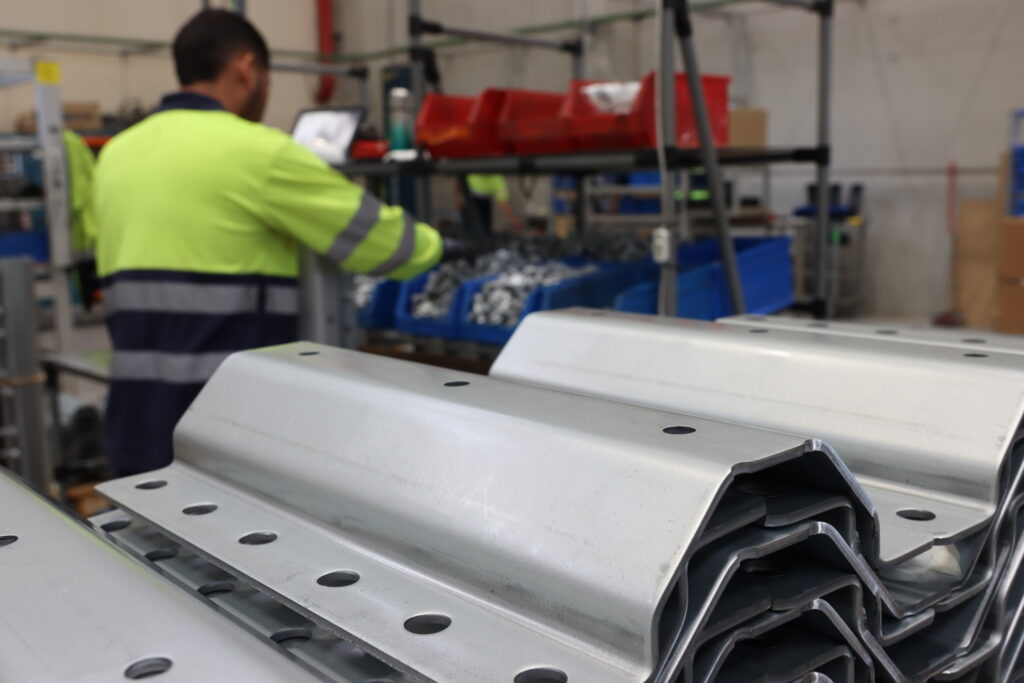
A pre-assembled solar tracker does not eliminate the need for field labor. What it does is reduce unnecessary work on site by shifting selected assembly tasks to a more controlled manufacturing environment.
Instead of receiving multiple loose components that must be sorted, handled, and assembled in the field, crews work with installation-ready subassemblies that simplify the installation sequence and reduce manual effort at critical points.
Fewer manual operations at each installation point
When a system arrives more prepared from the factory, the number of tasks that must be completed on site is reduced. This helps shorten installation time, simplify execution, and lower the operational burden on crews during the most demanding phases of the project.
A simpler and more repeatable installation process
A pre-assembled approach also supports a more standardized and repeatable installation process. Instead of spending time assembling multiple parts at each installation point, teams can move forward with a more streamlined workflow, with fewer interruptions and less exposure to assembly-related errors.
Material handling and site organization also improve
Pre-assembly does not only affect installation steps. It also has a direct impact on material handling on site. By reducing the number of individual parts, it becomes easier to manage storage, reduce space requirements, and simplify stock control.
This helps minimize losses, errors, and the time spent locating, sorting, or replacing components. Taken together, it supports better use of human resources and improves overall site organization.
Modular design as a productivity advantage
This is where modular tracker design becomes especially important. A tracker system designed with pre-assembly in mind can help standardize installation tasks, improve repeatability, and reduce the operational pressure on crews.
As a result, installation becomes more efficient and easier to manage. This supports faster solar construction and helps maintain a better installation rhythm during the most labor-intensive stages of the project.
Less manual work, better execution quality
Field labor savings are also closely linked to execution quality. When crews are required to complete fewer assembly steps on site, the likelihood of missing parts, incorrect fasteners, rework, or inconsistent installation can also be reduced.
Simplifying field work helps limit that exposure and contributes to a more consistent installation process across the entire plant.
Greater predictability and lower schedule risk
Another key advantage is predictability. Labor-intensive installation models create more opportunities for variability between crews, shifts, and project locations. By contrast, a pre-assembled approach helps reduce this variability by moving part of the work upstream, before the product reaches the site.
For EPC teams, this can translate into more stable execution, better day-to-day planning, and lower schedule risk across the project.
PVH’s approach: pre-assembly as an execution advantage
At PVH, pre-assembly is approached as an execution advantage, not just a logistics feature. By reducing on-site components and simplifying installation workflows, it helps create a more efficient model for utility-scale project delivery.
For developers and EPCs, the value is clear: when field work becomes simpler, projects become easier to install, easier to coordinate, and easier to deliver on time.
Reducing field labor also means reducing complexity
In utility-scale solar, reducing field labor is not only about using fewer resources. It is also about reducing complexity, minimizing friction, and improving the project’s ability to move forward efficiently.
That is why a pre-assembled tracker system does not only improve installation. It also helps teams build with more control, more consistency, and more confidence from day one on site.
Looking to reduce field complexity and improve installation productivity? Discover how PVH’s pre-assembly approach supports more efficient utility-scale execution.
