
When tracker solutions are evaluated, most conversations focus on structural design, wind performance, or cost per watt. But for EPC teams, one of the most important differences often appears later, during installation. The comparison between a pre-assembled solar tracker and a field-assembled tracker is not only about product design. It is about what actually changes on site in terms of productivity, execution complexity, and installation risk.
Why does this difference matter on site?
In utility-scale solar projects, efficiency is not only defined by engineering performance. It is also shaped by how the system is installed. Every additional component, every manual step, and every assembly point adds complexity in the field and increases the need for coordination, quality control, and troubleshooting.
That is why, when evaluating a solar tracker system, it is not enough to look only at how it performs once installed. It is also critical to understand how it arrives on site and how much work still needs to be completed in the field.
What happens with a field-assembled tracker?
In a field-assembled model, more work remains to be completed once the material reaches the project site. Crews receive a larger number of loose components, more fasteners, and more intermediate assemblies that must be handled, sorted, positioned, and installed in the correct sequence.
More parts, more steps, and more dependence on field coordination
This approach creates a heavier operational burden on site. It is not only about managing more parts, but also about dealing with more interfaces between components and more critical manual installation steps. As a result, execution depends more heavily on crew coordination, tool availability, and correct sequencing in the field.
What changes with a pre-assembled solar tracker?
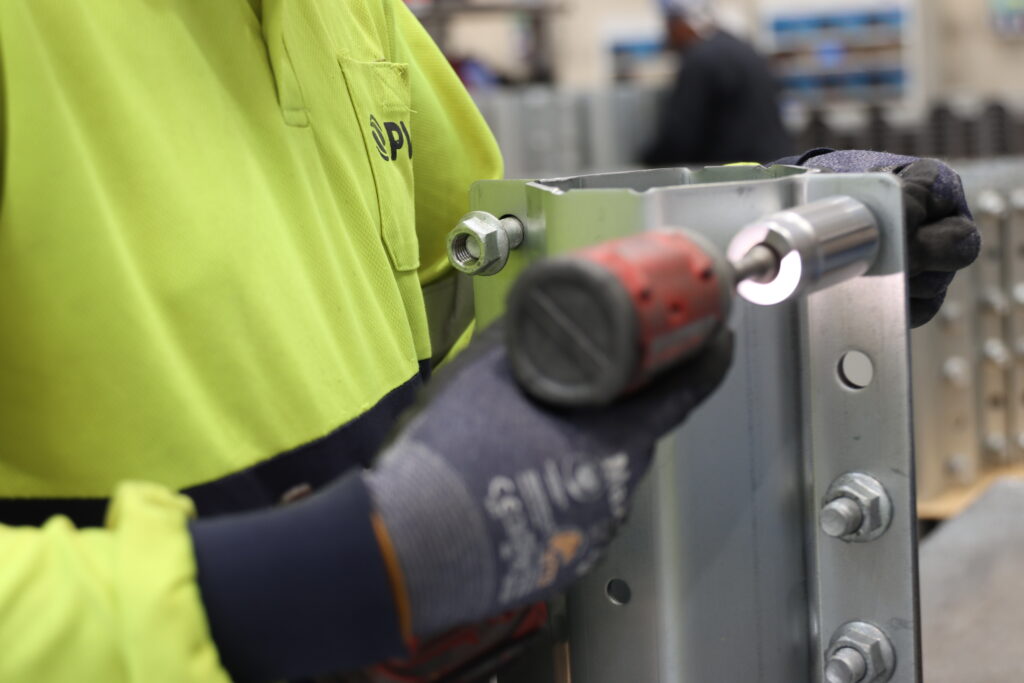
With a pre-assembled approach, part of that work is transferred to the factory. There, selected assemblies can be prepared in a controlled environment using standardized processes and repeatable workflows.
Installation-ready assemblies
This allows specific components to arrive on site ready for installation, reducing the number of items crews need to handle directly in the field. The result is a cleaner and more controlled installation process: fewer assembly operations, fewer interfaces between parts, and a more streamlined workflow on site.
More control from the start
Shifting part of the assembly process to the factory also helps improve consistency, reduce variability, and support better quality control. These advantages are much harder to achieve in the field, where site conditions can change quickly and execution depends on multiple operational factors.
Productivity impact: a more repeatable and efficient installation process
One of the first differences becomes clear in productivity. With a modular tracker design and a higher level of pre-assembly, installation becomes more repeatable and less exposed to variability between crews.
Instead of assembling multiple components on site, teams work with installation-ready units that simplify the sequence of work. This supports faster solar construction and reduces the likelihood of bottlenecks during the most demanding installation phases.
Labor impact: fewer operations in the field
The second major difference is labor. A field-assembled system places more pressure on crew availability and site organization because each installation point may require more parts, more tools, and more assembly decisions.
A pre-assembled tracker helps reduce field labor requirements by lowering the number of operations that must be completed on site and reducing the effort needed at critical installation points. For EPC teams, this can translate into better resource allocation and lower exposure to inefficiencies during execution.
Execution quality: less rework and more consistency
Field assembly always carries a level of risk. Missing parts, incorrect fasteners, material damage, or inconsistent assembly quality can affect installation flow and lead to rework.
When more of the work is completed before delivery, those risks are easier to control. That is why pre-assembly can also help reduce rework and improve installation consistency across the entire plant.
Schedule impact: how pre-assembly helps reduce delay risk
In utility-scale solar, delays rarely come from one major issue alone. More often, they are the result of accumulated friction: extra handling, extra checks, extra corrections, and extra coordination between teams.
That is exactly where pre-assembly creates value. By simplifying what happens on site, it helps reduce execution complexity and supports a more stable and predictable installation rhythm. As a result, it can also help lower schedule risk for EPC projects.
What PVH’s pre-assembly approach shows
PVH’s pre-assembly approach shows how significant this difference can be on site. With more than 70% fewer on-site components, 44% installation time reduction, and up to 96% fewer elements to assemble in the field, the impact goes beyond tracker design alone.
In practical terms, this means moving from managing dozens of parts at each installation point to working with a single pre-assembled unit. That shift can make a measurable difference in productivity, execution simplicity, and schedule control.
Tracker performance is not the only question
When comparing pre-assembled and field-assembled trackers, the key question should not be only which solution performs better once installed. It should also be which one allows the project to be built more efficiently from day one on site.
Because for EPC projects, a simpler installation process is not just an operational advantage. It is a way to reduce risk, improve consistency, and protect project schedules.
Want to understand what a pre-assembled tracker changes on site? Explore how PVH helps simplify installation from the factory to the field.
